Work Lights for Telehandlers in New Zealand: What to Fit and Where
In this guide
- What Telehandler Lights Are
- Road Lighting Kit for a Telehandler in New Zealand
- Work Lights on the Boom, Cab and Rear
- Amber Warning Beacons for Telehandlers
- Where to Mount Work Lights on a Telehandler
- LED Retrofit Options for Older Telehandlers
- Brand-Specific Fitment for JCB, Manitou, Merlo and Caterpillar
- Common Questions About Telehandler Lighting
- Pulling It Together
A telehandler carries 4 categories of lighting: road lights for travel between yards, fields and sites, work lamps for the boom and cab, an amber beacon for visibility, and reverse and brake lighting for yard safety. The full set must work together, sit at the right mounting positions, and meet the Land Transport Rule: Vehicle Lighting 2004 whenever the machine moves on a public road. This guide covers each category in turn, explains how New Zealand rules treat work lamps and beacons, lists the lumen ranges and approvals that matter, and gives general fitment pointers for the common telehandler makes.
What Telehandler Lights Are
Telehandler lights are the complete set of lamps fitted to a telescopic handler for road travel, working illumination, warning visibility, and reversing safety. The set covers 4 functions: lighting the road ahead, lighting the work area around the boom and the rear axle, signalling the machine’s presence to other traffic, and lighting the path behind when reversing.
Telehandler lights split between road lights (covered by the Land Transport Rule: Vehicle Lighting 2004 and the approval standards it accepts) and work lights for the yard, paddock or site. Road lights need a recognised approval, and an E or e mark is accepted in New Zealand. Work lights do not need road approval, but they are for use off the road and should be switched off before the machine goes on the public road.
A typical telehandler from JCB, Manitou, Merlo, or Caterpillar is delivered with a base lighting kit for road use, then has work lights and often a beacon added by the dealer or the operator. The factory kit covers headlamps, indicators, brake lights, position lamps, reverse lamps, and a number plate light. Work lamps and the amber beacon are often fitted as accessories.
Road Lighting Kit for a Telehandler in New Zealand
The road lighting kit for a telehandler has 7 common components. The road lamps and reflectors should carry a recognised approval such as an E or e mark, and the safe approach is to replace lamps like for like with approved units.
| Component | Function | Approval mark | Notes |
|---|---|---|---|
| Headlamps (dipped + main) | Forward illumination on road | E or ECE R112 | H4 or H7 bulbs typical |
| Front position lamps | Sidelights for parked or moving | ECE R7 | Often combined with headlamp |
| Rear tail and brake lamps | Rear visibility and braking signal | ECE R7 | Combined or separate units |
| Direction indicators | Turning signals | ECE R6 | Front, rear, and (often) side repeaters |
| Reverse lamps | Reversing illumination | ECE R23 | Activates with reverse gear |
| Number plate light | Plate illumination | ECE R4 | White light, illuminates the plate |
| Reflectors (rear, red triangular) | Passive marking | ECE R3 | Red triangular at rear |
New Zealand rules expect more than many operators assume. A tractor or self-propelled agricultural machine used on the road should carry working position lamps, headlamps, rear lamps, stop lamps, direction indicators, rear reflectors and number plate lighting, plus amber warning lamps where NZTA requires them. A telehandler used on the farm as a self-propelled agricultural machine should be treated as needing that full set. If your machine is registered or used differently (for example on construction sites), check with NZ Transport Agency Waka Kotahi (NZTA) how it is categorised, and whether it needs a Warrant of Fitness or Certificate of Fitness. In practice, almost every modern telehandler leaves the factory with all of these lamps except the beacon, and any lamp that is fitted must work. Reversing lamps are optional, but if fitted they must show white light and be lit only when reversing.
Replacement road lamps fitted as part of repair should carry the same approval marks. A road lamp without the right approval mark does not comply, even if it looks identical. Missing or defective lamps can lead to an infringement notice.
Work Lights on the Boom, Cab and Rear
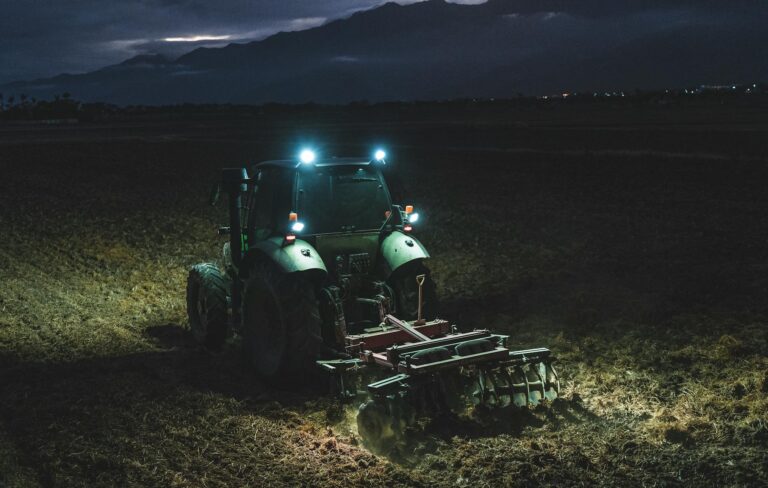
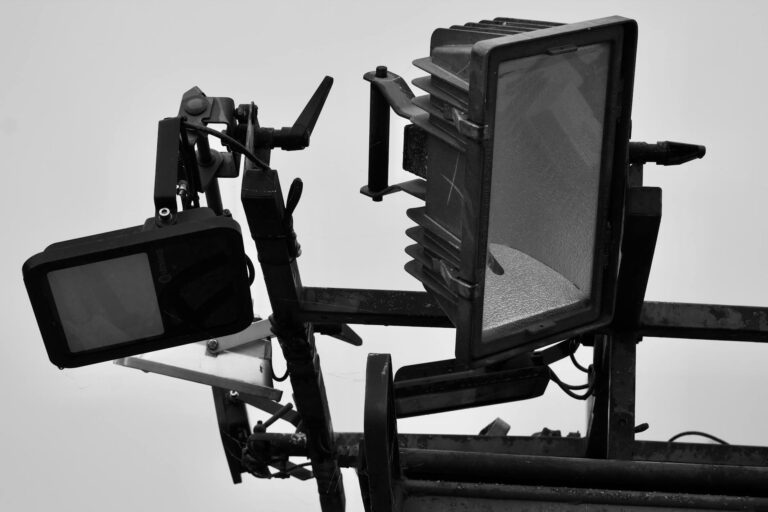
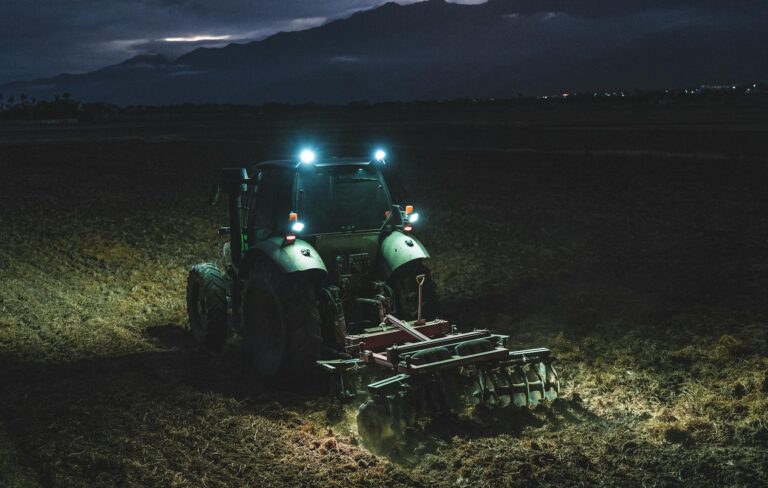
Work lights on a telehandler illuminate the working area around the boom tip, the cab roof, and the rear of the machine. Work lights run from 1,500 lumens (small fender or boom-base lamps) to 9,000 lumens (premium cab roof or boom tip floods).
Telehandlers carry work lamps in 3 mounting zones:
- Boom-mounted lights illuminate the load and the working face. A boom tip lamp lights the forks, the bale, the bucket, or the pallet at full extension. A boom base lamp lights the cab-side of the boom and the load when retracted.
- Cab-roof lights light the area in front of the cab and behind the cab. A pair of forward-facing cab roof lamps doubles as approach lighting on dark yards. A pair of rearward-facing cab roof lamps lights the reversing path when the machine backs into bays or silage pits.
- Rear and counterweight lights light the area immediately behind the machine. These are useful when the operator works in tight yards, around grain stores and sheds, or close to other machinery.
Beam pattern matters at every position. A flood pattern (60 to 120 degree beam angle) suits boom tip work because it lights a wide area on the load. A spot pattern (8 to 30 degree beam) suits cab roof or fender mounts where the lamp must reach a long way down the yard. A combo pattern blends the two and suits general use.
All of these lamps should be off on the public road. The vehicle lighting rules do not allow lamps that dazzle or confuse other road users, and rear white light is restricted on the road because it can look like an approaching vehicle. Rear-facing roof floods left on while drawing out bales are a classic way to blind the car behind. A separate switch with a tell-tale in the cab helps.
For a deeper dive on how flood and spot beams work, see our flood vs spot beam guide and the work light beam patterns article.
Amber Warning Beacons for Telehandlers
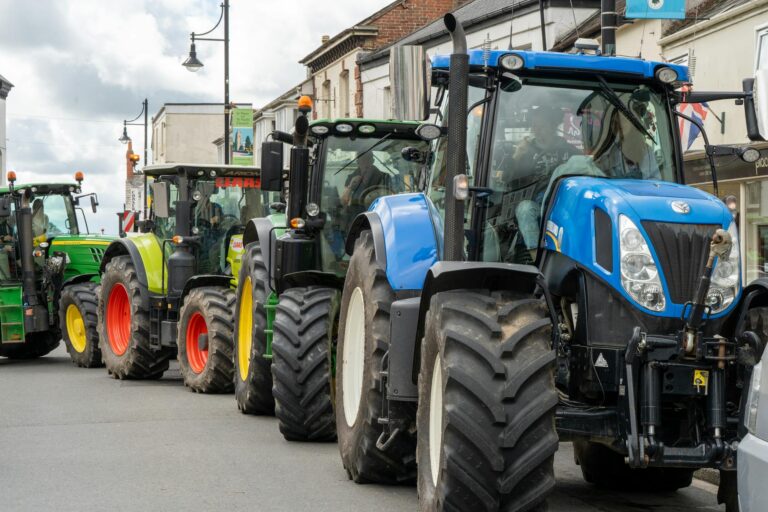
An amber warning beacon signals that the machine is slow-moving, large, or working in a yard or on a verge. In New Zealand, amber warning lamps are for vehicles that present a hazard, such as agricultural vehicles, road works and road maintenance vehicles, tow trucks and similar working vehicles.
The key New Zealand points are:
- NZTA requires amber flashing warning lamps on agricultural vehicles in a number of situations, such as oversize or slow-moving operation on the road. Check NZTA’s agricultural vehicle guidance for the exact requirement for your machine, and run the beacon on every road trip as good practice.
- The beacon should be mounted on the roof where possible, on the centre line of the machine, high enough to be seen from all round.
- Oversize machinery faces further conditions under NZTA’s width bands, such as hazard warning panels, daylight-only travel and pilot vehicles. Few telehandlers are that wide, but it applies to some other self-propelled kit.
The trigger is different from the UK, where a beacon is tied to road type and design speed. In New Zealand, a slow or wide farm telehandler on the road without its beacon on may not be compliant. ECE R65 is the recognised performance standard for warning beacons, and many sites and contracts specify it.
Beacons mount via 4 standard methods on a telehandler: a DIN pole on the cab roof, a magnetic base for portable use, a flexi DIN mount that absorbs cab vibration, and a 3-bolt fixed mount on a roof rail. A fixed or flexi DIN mount is the better choice for a machine that goes on the road regularly, since the beacon should be on every time the machine leaves the yard. LED beacons draw 1 A to 2 A at 12V, weigh 350 g to 800 g, and last 30,000 to 50,000 hours. Halogen beacons draw 5 A to 7 A and last 500 to 1,500 hours.
For more on beacons, see our amber beacon meaning article, the ECE R65 beacons explainer and NZTA Waka Kotahi’s guidance for agricultural vehicles.
Where to Mount Work Lights on a Telehandler
Work light mounting positions on a telehandler are dictated by the chassis, the boom geometry, and the cab structure. The 6 standard mounting positions are:
| Position | Function | Lamp type |
|---|---|---|
| Boom tip (top of the boom) | Lights the load at full extension | Single or twin LED flood, 4,000 to 6,000 lm |
| Boom base (where boom meets chassis) | Lights the load when boom is retracted | Single LED flood, 3,000 to 4,500 lm |
| Cab roof front | Forward floodlight for yard approach | Pair of LED combo lamps, 6,000 to 9,000 lm each |
| Cab roof rear | Rearward floodlight for reversing | Pair of LED flood lamps, 4,500 to 6,000 lm each |
| Fender or wheel arch | Side illumination, ground-level work | Compact LED flood, 1,500 to 3,000 lm |
| Counterweight or rear chassis | Rear ground-level work | Compact LED flood, 1,500 to 3,000 lm |
The boom tip lamp must be wired with cable that flexes through the boom’s full travel without chafing. Most boom tip kits use a coiled extension cable or a dedicated harness routed inside the boom. A cab roof lamp can use a standard fixed cable run through the bulkhead.
Mounting height matters for beam reach. A cab roof lamp at 3.0 m elevation lights the ground 25 to 35 m ahead. A fender lamp at 1.5 m elevation lights the ground 8 to 12 m ahead. A boom tip lamp moves with the boom, so its reach is variable.
On the road, lower and retract the boom and keep forks or attachments down. Raised forks and front-mounted handling attachments are a dangerous projection on a public road.
For step-by-step bracket and bolt selection, see how to mount work lights.
LED Retrofit Options for Older Telehandlers
LED retrofit on an older telehandler upgrades the original halogen or sealed-beam work lamps to higher-output, longer-life LED units. The retrofit covers 3 areas: headlamp bulbs, work lamps, and the amber beacon.
LED retrofit options for telehandlers:
- LED work lamps in place of halogen work lamps. Road headlamps are a different matter: NZ rules require headlamps to meet an approved standard and not to dazzle, and LED retrofit bulbs in halogen H4 or H7 headlamps generally do not meet that. Fit complete approved LED headlamp units if the headlamps need upgrading. EMC compliance (ECE R10) matters because LED drivers can interfere with vehicle electronics.
- Direct-replacement LED work lamps to replace square or round halogen work lamps. The lamps bolt into the existing brackets and use the same 2-pin Deutsch or AMP connector.
- LED amber beacon swap to replace a halogen rotating beacon. LED beacons sit on the same DIN pole or magnetic base, and the lower current draw suits a beacon that runs every time the machine is on the road.
A telehandler with monitored lighting circuits can throw a bulb-failure warning if a non-CANbus LED bulb is fitted. The fix is a CANbus-compatible LED bulb with a built-in load resistor, or a separate inline resistor wired in parallel.
For a full halogen-to-LED comparison, see our LED vs halogen guide and the halogen to LED upgrade article.
Brand-Specific Fitment for JCB, Manitou, Merlo and Caterpillar
Telehandler lighting fitment varies by manufacturer, model and year because the cab, boom, and chassis geometries differ. On JCB, Manitou, Merlo and Caterpillar machines, check the operator’s manual or the existing lamps for the bulb types, connector types and mounting points before ordering. Cab roof lamps usually bolt to factory points or a roof rail, boom tip lamps often need an aftermarket bracket and a flexible cable run, and a beacon may be factory or dealer fitted.
For a full JCB telehandler lighting fitment guide, see our JCB telehandler lights article.
Common Questions About Telehandler Lighting
What lights does a telehandler need on the road in New Zealand? A farm telehandler used as a self-propelled agricultural machine should have working headlamps, position lamps, rear lamps, stop lamps, front and rear indicators, number plate lighting and red rear reflectors, plus an amber warning beacon where NZTA requires one. Road lamps should carry a recognised approval such as an E or e mark. Check with NZTA if your machine is categorised differently.
Where should work lights be mounted on a telehandler? Work lights mount in 6 positions: boom tip, boom base, cab roof front, cab roof rear, fender, and counterweight. Boom-tip lamps light the load. Cab roof lamps light the yard. Fender and counterweight lamps light the immediate ground work area. All of them must be switched off before the machine goes on a public road.
Does a telehandler need an amber beacon in New Zealand? NZTA requires amber flashing warning lamps on agricultural vehicles in a number of situations, such as oversize or slow-moving operation on the road, so check NZTA’s guidance for your machine and run the beacon on every road trip as good practice. Most site safety policies also require a beacon during operation.
Can you fit LED work lights to an older telehandler? A telehandler that uses halogen or sealed-beam work lamps can be upgraded with direct-replacement LED units. The upgrade fits the original bracket, uses the original connector, and increases output by 2 to 3 times. CANbus machines may need load-resistor LED bulbs.
How many lumens do telehandler work lights need? A telehandler work lamp needs 1,500 lumens for fender and counterweight positions, 3,000 to 4,500 lumens for boom-base mounts, 4,000 to 6,000 lumens for boom-tip work, and 6,000 to 9,000 lumens for cab roof floodlights.
Pulling It Together
Telehandler lights cover 4 functions across 6 mounting positions. The road kit must carry a recognised approval such as an E or e mark and be fitted and working whenever the machine is on the road. Work lamps in the 1,500 to 9,000 lumen range light the boom, cab, and rear, and should be off on the public road. An amber beacon, ideally to R65, should be on whenever a farm telehandler is on the road, and NZTA requires one in many situations. Older machines can take direct-replacement LED units that boost output, cut current draw, and last 30 to 50 times longer than halogen.
Browse the full work lamp range at agri-lighting.co.nz, shipped from the UK with free delivery to New Zealand on orders over NZ$500 (prices in NZ dollars, with any NZ GST, duty or Customs fees paid on delivery), or contact our team on +44 1522 440522 or [email protected] for fitment advice on a specific telehandler model.