Tractor Lighting Regulations in New Zealand: Everything You Need to Know for Road Use
In this guide
- The Law Behind Tractor Lighting Regulations
- The Lighting System a Tractor Needs
- Does Design Speed Change the Lighting Rules?
- Hours of Darkness and Poor Visibility
- Work Lights and Road Use
- Amber Beacon Requirements for Tractors
- Trailer and Implement Lighting
- Enforcement, Penalties, and Staying Compliant
- Summary
Tractor lighting regulations in New Zealand determine which lights a tractor must carry before it can legally travel on a public road. The rules are not optional. They are set out in the Land Transport Rules, administered by NZ Transport Agency Waka Kotahi (NZTA), enforced on the road by Police, and missing or faulty lamps can mean an infringement fee. The problem for most farmers is that the rules are spread across several documents, have been amended many times, and use language designed for lawyers rather than people who actually drive tractors. This article puts it in one place, in plain English, organised by what you actually need to know: the lighting system a tractor needs, the hours of darkness, and the rules for work lights, beacons, trailers and implements.
For a broader look at tractor lighting beyond regulations, see our Complete Guide to Tractor Lighting.
The Law Behind Tractor Lighting Regulations
The Land Transport Rule: Vehicle Lighting 2004 is the principal New Zealand rule on vehicle lighting. It sets out which lamps vehicles must carry, lamp colours, dazzle, when lamps must be used and how warning lamps may be fitted. It has been amended several times since 2004, so always check the current consolidated version on the NZTA Waka Kotahi website.
For farm machinery, the key point is that tractors and other agricultural vehicles have their own treatment within the Land Transport Rules. NZTA Waka Kotahi groups them under the “agricultural vehicle” category, with specific provisions on lighting, width and speed, and with amber warning lamps (beacons) required in various situations such as oversize or slow-moving operation. NZTA publishes guidance for agricultural vehicles that explains the rules in plain terms, and it is the first place to check for your machine.
Lamps themselves must meet a recognised standard. New Zealand accepts UN ECE (E-mark) approval, and some other standards such as SAE and the Australian Design Rules. New European tractors arrive built to EU type approval, so their factory lamps already carry E or e marks.
The rules apply whenever a tractor is used on a road, which includes any place the public has access to. A tractor used only on the farm, in paddocks and on private farm tracks with no public access is outside them, but the moment it turns onto a public road, the requirements apply in full.
The Lighting System a Tractor Needs
A modern agricultural tractor or self-propelled agricultural machine used on a New Zealand public road normally carries:
- Front position lamps. White lamps, one each side, showing the tractor’s width.
- Headlamps. Dipped and main beam, white, aimed so they do not dazzle.
- Rear lamps. Red tail lamps, one each side.
- Stop lamps. Red, lighting when the brakes are applied.
- Direction indicators. Amber, front and rear on each side.
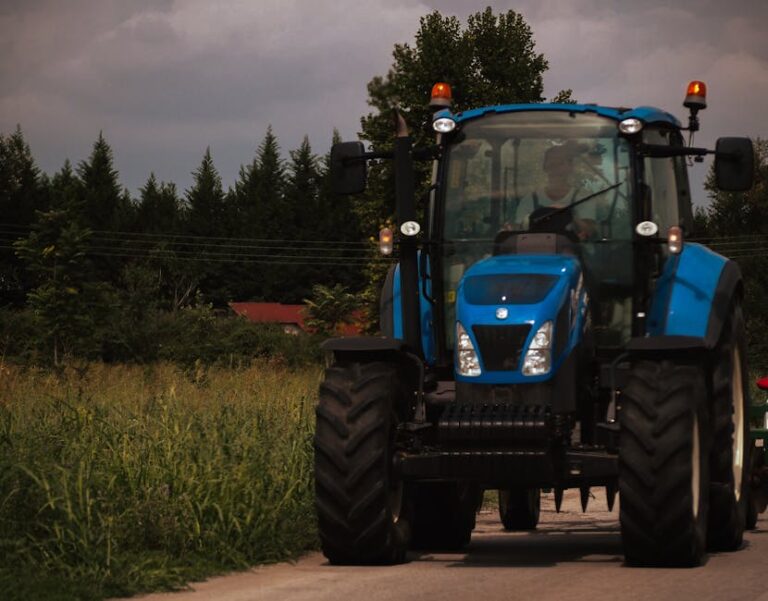
- A flashing amber beacon. Required in a range of situations, such as oversize or slow-moving operation.
- Number plate lighting. Where a rear registration plate is carried.
Red rear reflectors complete the set. Exactly which of these lamps is compulsory depends on the tractor’s age, width, speed and how it is used, so check NZTA Waka Kotahi’s agricultural vehicle guidance for your machine. In practice, a modern tractor leaves the factory with all of them, and any lamp that is fitted must work.
The general colour rules are simple: white to the front (headlamps, position lamps, daytime running lamps), red to the rear (rear lamps, stop lamps, rear fog lamps, rear reflectors) and amber for indicators, side marker lamps and side reflectors. No white light may show to the rear apart from reversing lamps and number plate lamps.
Any lamp that is fitted must be clean, unobscured and working whenever the tractor is on a public road, including optional lamps such as a rear fog lamp or reversing lamps.
Older and vintage tractors
Older tractors, and tractors used only in daylight, can have fewer lighting requirements under New Zealand rules. The detail depends on the tractor’s age and use, so check NZTA Waka Kotahi’s current rules if your tractor is close to the line. Older tractors that do have lights fitted must keep them working.
Does Design Speed Change the Lighting Rules?
Speed matters more in New Zealand than many farmers expect. Agricultural vehicles have their own speed provisions, and the speed a tractor is driven at can change what rules apply to it.
Design speed and operating speed matter for these reasons:
- Inspections. Many agricultural vehicles do not need a Warrant of Fitness (WoF) or Certificate of Fitness (CoF), but this depends on how fast and how the vehicle is operated. A tractor that needs a WoF or CoF will have its lights checked at that inspection.
- Warning lamps. Beacon requirements are linked to how the vehicle is operated, including slow-moving and oversize operation.
- Licence. The licence class you need depends on the tractor’s weight and how it is used. Check NZTA Waka Kotahi’s licensing guidance for agricultural vehicles.
- Oversize. Wider machines move into oversize categories, with extra requirements for warning lamps, signs, travel times and sometimes pilot vehicles.
For reliable tractor tail lights that combine stop lamps, rear lamps and indicators in a single unit, LED rear clusters are now the standard upgrade.
Hours of Darkness and Poor Visibility
New Zealand rules use the term hours of darkness: in general, the period from half an hour after sunset to half an hour before sunrise, plus any other time when there is not enough daylight to see people and vehicles clearly. Headlamps, rear lamps and number plate lighting must be lit during the hours of darkness.
Daylight does not mean anything goes. Any required lamp must still be fitted and working, the beacon must be on whenever the rules call for it, and driving with dipped headlights by day makes a slow tractor easier to see if it has no daytime running lamps.
In fog, use dipped headlights and fog lamps, reduce speed and keep a safe distance. Fog lamps are for poor visibility only and should be switched off once visibility improves, so they do not dazzle other drivers.
At dawn and dusk, when light levels drop but the hours of darkness have not started, a tractor travelling at 30 km/h on a rural road is very hard for faster traffic to see. Dipped headlights and the beacon at these times are sensible, and many modern tractors switch their lights on automatically.
Work Lights and Road Use
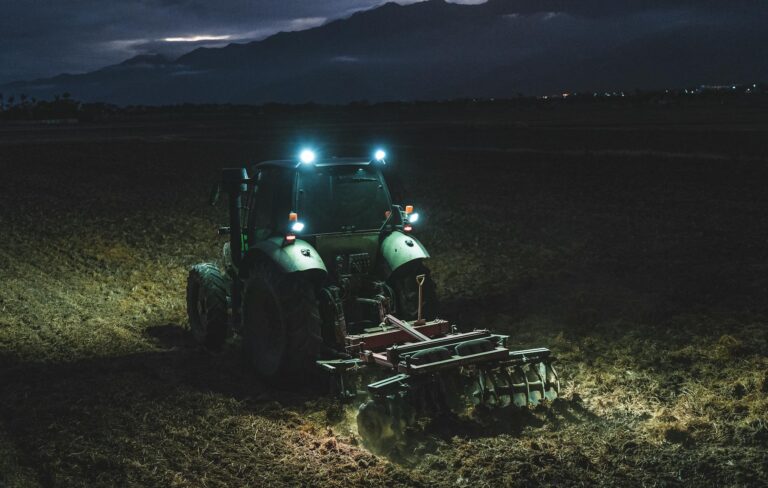
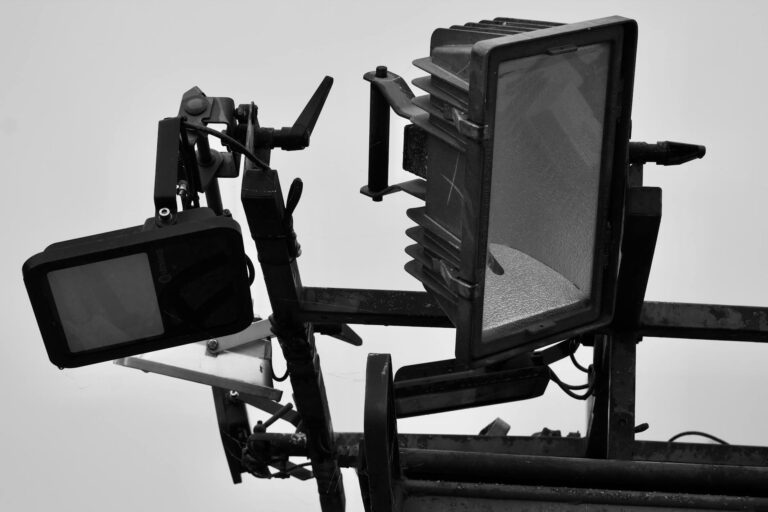
Work lights must not be used as driving lights on public roads. The vehicle lighting rules say no lamp may dazzle or confuse other road users, and work lamps are designed to light a working area, not the road. A forward-facing work light produces a broad, intense flood of white light designed to light a paddock, not a road. Directed at oncoming traffic, that light is blinding.
Rear-facing work lights are no exception. White light shown to the rear while driving can look like an approaching vehicle, which creates confusion about which way the tractor is travelling, particularly on unlit rural roads at night.
The rules do not ban work lights on tractors. A tractor can carry them and use them on private land without restriction. On a public road they may stay fitted but should be off while driving.
The safest practice: switch all work lights off at the gate before pulling onto any public road, and switch them back on only after leaving the road.
Amber Beacon Requirements for Tractors
In New Zealand, an agricultural vehicle must show a flashing amber warning lamp in a range of situations on the road, such as oversize or slow-moving operation. The exact triggers depend on the vehicle’s width, speed and how it is being operated, so check NZTA Waka Kotahi’s agricultural vehicle guidance for the exact requirement for your machine. Many farmers simply run the beacon on every road journey, which costs nothing and makes a slow tractor far easier to spot.
Fit the beacon where it can be seen from all round, usually on the cab roof. If a trailer or implement hides it from behind, add a second beacon further back. An ECE R65-approved beacon has tested colour and intensity and is the sensible choice.
Oversize agricultural vehicles have extra requirements, which can include additional warning lamps, signs and pilot vehicles depending on width. Check NZTA Waka Kotahi’s oversize guidance before moving wide machinery.
LED tractor beacon lights offer longer life, lower power draw and better resistance to vibration, making them a practical choice for tractors that spend hours on rough ground before heading onto the road. Browse the full range of tractor beacons at Agri Lighting for magnetic, bolt-on and pole-mount options.
Trailer and Implement Lighting
An agricultural trailer used on the road normally needs rear lamps, stop lamps, direction indicators and red rear reflectors, and number plate lighting where it carries a plate. If the trailer hides the tractor’s own rear lamps, its lamps are what following drivers rely on, so they must work.
Towed equipment without its own lights, such as balers, sprayers and rakes, needs lights if it hides the tractor’s front or rear lamps or reflectors. In that case a lighting board should be fitted. If a following driver cannot see the tractor’s rear lights because a bale trailer, cultivator or muck spreader is blocking them, the combination is not safe or compliant.
Length-Based Requirements
Long trailers and long tractor and trailer combinations can need side marker lamps and side reflectors. The lengths at which these apply are set in the Land Transport Rules, so check NZTA Waka Kotahi’s agricultural vehicle guidance for your combination.
Reflective Markings
Heavier, wider or longer trailers can also need retro-reflective markings and, on oversize combinations, warning signs. The thresholds and exemptions are set in the Land Transport Rules, so check the current rules for your trailer rather than relying on overseas figures.
Projecting Loads
Loads that stick out beyond the front, back or sides of a tractor or trailer must be marked so other road users can see them, typically with a flag by day and lamps or reflectors at night. The exact distances are set in the Land Transport Rules and explained in the NZ Road Code. Lowering front loaders and forks on the road is also good practice, as raised forks are a dangerous projection.
Practical Considerations
Check trailer lighting before every road journey. Vibration from paddock work loosens connections, bulbs blow, and lenses crack. A 2-minute walk-around with the tractor’s lights on catches problems that would otherwise result in a roadside stop, an infringement fee, or worse.
Enforcement, Penalties, and Staying Compliant
New Zealand Police enforce road rules, including vehicle lighting, and the Commercial Vehicle Safety Team carries out roadside checks on heavy vehicles. Driving a vehicle without the required lamps, or with defective lamps, can mean an infringement fee, and a vehicle with serious defects can be ordered off the road until it is fixed. Check the current infringement amounts with NZTA Waka Kotahi or Police, as they can change.
The most common lighting problems for tractors are:
- Defective or missing lights. A blown tail light bulb, a dead stop lamp, a cracked indicator lens or a missing rear reflector.
- Work lights left on. Particularly common in winter when drivers move between paddock and road.
- Beacon not switched on. Where the rules require it, it must be on for every road journey, including short runs between paddocks.
- Obscured lights. Mud, crop residue, or a badly positioned implement covering one or more required lamps without a lighting board.
Staying on the right side of the tractor lighting regulations is not complicated. It comes down to a few habits:
- Walk around the tractor before every road journey. Check that all required lights are present, clean, and working. Have someone press the brakes and activate indicators while you check from behind.
- Carry spare bulbs. A small kit with spare position lamp, headlight, and indicator bulbs takes up no space and can prevent an infringement fee.
- Beacon on, work lights off, at the gate. Make it part of the routine, the same as checking mirrors.
- Upgrade to LED where possible. LED lamps last longer, resist vibration better, and draw less current from the tractor’s electrical system. A blown filament bulb at the wrong moment turns a routine road trip into a legal problem.
- Check trailer connections every time. Plug in the trailer, switch on every light circuit, and confirm each lamp responds before pulling onto the road.
Summary
Tractor lighting regulations in New Zealand follow a simple structure: a tractor used on the road needs its required lamps (normally position lamps, headlamps, rear lamps, stop lamps, indicators, reflectors and number plate lighting) fitted and working, with an amber beacon whenever the rules call for it, such as in oversize or slow-moving operation. Agricultural trailers need rear lamps, stop lamps, indicators and reflectors, plus marker lamps and markings on longer or larger combinations. The Land Transport Rule: Vehicle Lighting 2004 and NZTA Waka Kotahi’s agricultural vehicle rules set the legal framework, and Police enforce it on the road.
The single most effective thing any tractor driver can do is build a 2-minute lighting check into the routine before every road journey. Clean lamps, working bulbs, the beacon on and work lights off keep you compliant, visible and safe.
Browse the full range of tractor lighting at Agri Lighting, including LED upgrades, tractor beacon lights, tractor tail lights, and trailer lighting solutions. Orders ship from the UK with free delivery to New Zealand over NZ$500, prices are in NZ dollars, and any NZ GST, duty or Customs fees are paid on delivery.